

More and more dental offices in Santa Clarita and across the country are advertising Invisalign and braces as in-house services. On the surface, it sounds convenient. One office, one team, one appointment. What many patients do not realize until something goes wrong is that there is a significant difference between a dentist who has completed a weekend Invisalign certification course and a board-certified orthodontist who spent years training exclusively in tooth movement, jaw development, and bite correction. That difference matters enormously for your outcome, your health, and in some cases, your wallet.
At Embrace Your Smile Orthodontics, our doctors have seen firsthand the complications that arise when orthodontic treatment is performed without proper training. We are not here to criticize general dentists, who do excellent and essential work in their own field. We are here to help you understand why the two are not interchangeable when it comes to straightening your teeth.
Call our office at (661) 259-2388 to schedule a complimentary consultation and find out what a specialist can do for your smile.
The Training Gap: 10 Years vs. Weekend Seminars
Becoming an orthodontist requires a commitment that goes far beyond dental school. After completing four years of undergraduate education and four years of dental school, an orthodontist must then complete an additional two to three year accredited residency program focused exclusively on orthodontics and dentofacial orthopedics.
This residency covers tooth movement, skeletal growth, bite analysis, airway considerations, facial esthetics, and the full range of orthodontic appliances and techniques. Board certification, which requires demonstrating clinical excellence across a range of complex cases, takes the credential even further. Only about one in three orthodontists achieve it.
By contrast, many general dentists who offer Invisalign or braces do so after completing continuing education courses, some of which can be completed in as little as one weekend. Align Technology, the company behind Invisalign, sells access to their system to any licensed dentist who completes their training program.
That training does not include the years of clinical orthodontic experience necessary to diagnose and manage complex bite issues, growth patterns, or cases that require more than simple tooth alignment. The result of these lax requirements is a gap between what a dentist is trained to do and what orthodontic treatment actually demands. Too many times, the patients end up stuck in the middle of it.
Common Risks When Dentists Handle Orthodontics
Misdiagnosis: Airway Issues and Crossbites Missed
Orthodontic diagnosis is about far more than looking at crooked teeth. A trained orthodontist evaluates the relationship between the upper and lower jaws, assesses skeletal growth patterns, considers the airway, and identifies issues like crossbites, underbites, and open bites that require specific interventions to correct properly. General dentists are not trained to perform this level of diagnosis.
Airway issues are a particularly important example. Narrow palates and restricted airways in children can have significant long-term health consequences, including sleep-disordered breathing. An orthodontist can identify these issues early and recommend two-phase treatment or palatal expansion to address them before they worsen. A dentist offering Invisalign is unlikely to screen for these conditions, let alone treat them.
Crossbites that require skeletal expansion are similarly easy to miss without orthodontic training. Treating the visible crowding while leaving an underlying crossbite unaddressed does not fix the problem. In fact, it often makes it worse.
Ineffective Treatment: When Invisalign Is Not Enough on Its Own
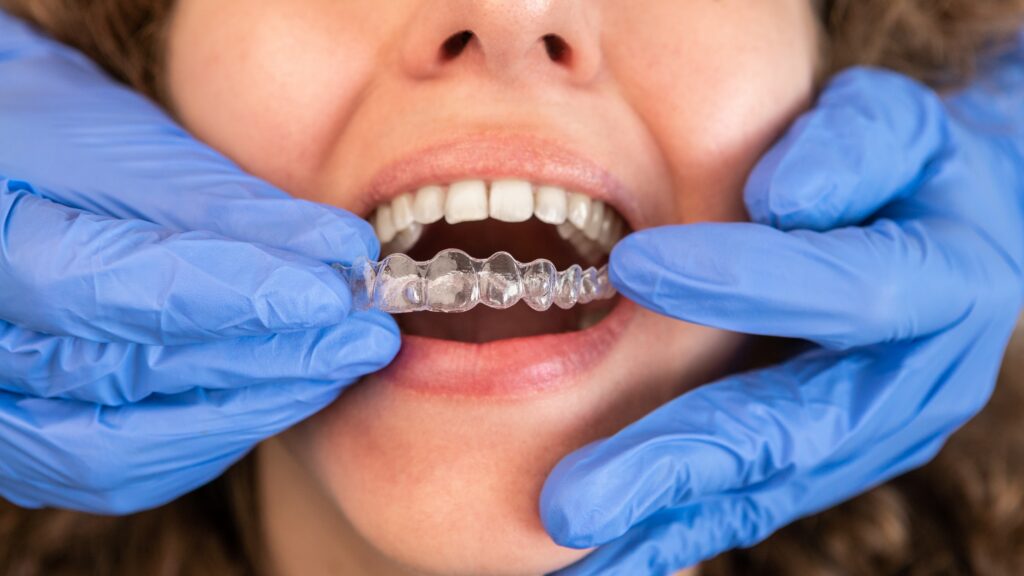
Invisalign is a powerful tool in the hands of an experienced orthodontist, but it is not appropriate for every case, and it does not work the same way in every set of hands. Complex cases, including significant bite discrepancies, rotations, and situations requiring skeletal movement, often need adjunctive tools like TADs (temporary anchorage devices) or micro-screws to achieve the desired outcome. These are orthodontic techniques that general dentists are not trained to use.
When a complex case is treated with Invisalign alone by a provider without the training to recognize its limitations, the result is often partial correction. Teeth may look straighter, but the bite is off, the roots are not properly positioned, or the underlying problem was never fully addressed. Correcting that requires starting over with a specialist, at additional cost and additional time.
Relapse: What Happens Without Long-Term Retention Planning
Getting teeth straight is only half of the orthodontic process. Keeping them straight requires a carefully planned retention protocol that accounts for the patient's specific case, the type of movement performed, and the long-term stability of the result. Orthodontists are trained in retention planning. Many general dentists offering orthodontic services are not.
Without proper retention guidance, teeth shift. Patients who invested time and money in treatment find themselves watching their results fade, often within months of finishing. By the time they arrive at an orthodontist's office to address the relapse, the straightforward correction they thought they received has become a more involved case.
When General Dentistry Falls Short
General dentistry is essential. Regular cleanings, fillings, crowns, and preventive care are the foundation of a healthy mouth, and a great relationship with your general dentist is something we actively encourage. But the skill set that makes an excellent general dentist does not transfer directly to orthodontic treatment.
Orthodontics requires the ability to predict jaw growth in children and teenagers, manage tooth movement within the context of facial esthetics, and identify systemic issues that affect treatment outcomes. These are not skills acquired in dental school. They are developed through years of dedicated specialty training.
In Santa Clarita, we have seen a growing trend of patients who started Invisalign at a general dental office and ended up at our practice when complications arose or their results stalled. "Quick Invisalign" offerings at general practices sound appealing, but when cases exceed what the provider is trained to manage, patients bear the consequences. What was marketed as a simple, fast solution becomes a longer and more expensive process to repair.
Choose Embrace Your Smile for Proven Results
At Embrace Your Smile Orthodontics, our board-certified orthodontists, Drs. LeCornu, Gilbertson, and Asinas, have spent their careers mastering the full scope of orthodontic care. Our services include:
- Braces
- Invisalign
- Surgical Orthodontics
- Two-Phase Treatment
- iTero Digital Scanning
- Professional Teeth Whitening
- Custom Mouthguards
We have been voted Santa Clarita's Best Orthodontist for eleven consecutive years because our patients see the difference that specialization makes. A beautiful, healthy smile that stays straight for life is not a product. It is the result of expert diagnosis, careful treatment planning, and the kind of long-term thinking that only comes from dedicated orthodontic training.
If you have been considering Invisalign or braces, or if you are concerned about results from treatment you started elsewhere, we invite you to come in for a complimentary consultation. Contact Embrace Your Smile Orthodontics today at (661) 259-2388 and let our specialists show you what your smile is really capable of.